More Than Allegory: On Religious Myth, Truth And Belief by Bernardo Kastrup
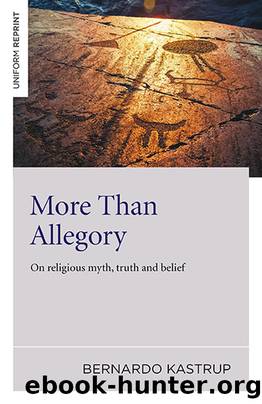
Author:Bernardo Kastrup [Kastrup, Bernardo]
Language: eng
Format: epub
ISBN: 9781785352881
Publisher: John Hunt Publishing
Published: 2016-04-29T03:00:00+00:00
Since there is no external reality, religious myths can only point to internal truths. They reveal our transcendent nature, for that which conjures up time and space cannot itself be bound by time or space. Religious myths also cancel out the transcendence-denying implications of cultural abstractions and lift us up to edge of the âholeâ of conditioning.
Religious institutions
I feel forced to briefly digress at this point, so to prevent misunderstandings of my position. My emphasis on the importance of true religious myths in contemporary culture and society should not be construed as blanket support for religious institutions and their actions. Although it is hard to imagine how religious myths could retain vitality without some form of institutional support, it would also be naïve to deny the defacement, abuse and misappropriation of religious mythology at the hands of institutions.
Indeed, religious myths have been routinely hijacked and corrupted for political and economic gain. They have been misused to establish and maintain the power of clergy. They have been abused as instruments of oppression and social control. Inconceivable harm has been done in their name, as any cursory reading of history will show. This doesnât eliminate the intrinsic validity and importance of true religious myths discussed earlier, but it must be acknowledged. Acknowledgement, after all, is the first step towards healing.
It is not too difficult to spot the misuse of religious mythology. The essence of a myth lies in its symbolic pointing at the internal truths of cognition; truths that are inside us, not in the world âout there.â As such, the relationship between true religious myths on the one hand, and codes of external conduct on the other, is indirect and ancillary at best. So when religious myths are used as justification for arbitrary moralsâmeant to tell people what to do and not to doâsuspicion is justified. When a house of worship begins to resemble a court of law, where the emphasis is on passing judgment and casting blame, one must wonder.
Moreover, by pointing at the inner truth of each person, true religious myths also contradict any alleged need for intermediaries or translators of any kind. The myth only has vitality if we develop a direct, personal, intimate relationship with it. No one can explain to us what the myth means since, as weâve seen in Part I, its meaning transcends words. âMake sure that your religion is a matter between you and God only,â134 advised Wittgenstein. So when religious myths are used to legitimize the power of people who place themselves between transcendence and us, the motivations for this must be questioned. When clergy become dictators instead of symbols of, and guides to, our own inner wisdom, something isnât quite right.
Because living the transcendent truth of a religious myth is a subtle and very personal phenomenon, not conducive to the gathering of adoring crowds, religious institutions often try to âtranslateâ the myth into pre-packaged dogmas that can be doled out like pills and practiced blindly like calisthenics. We are told that
Download
This site does not store any files on its server. We only index and link to content provided by other sites. Please contact the content providers to delete copyright contents if any and email us, we'll remove relevant links or contents immediately.
| Anthropology | Archaeology |
| Philosophy | Politics & Government |
| Social Sciences | Sociology |
| Women's Studies |
The remains of the day by Kazuo Ishiguro(8962)
Tools of Titans by Timothy Ferriss(8359)
Giovanni's Room by James Baldwin(7313)
The Black Swan by Nassim Nicholas Taleb(7097)
Inner Engineering: A Yogi's Guide to Joy by Sadhguru(6782)
The Way of Zen by Alan W. Watts(6589)
Asking the Right Questions: A Guide to Critical Thinking by M. Neil Browne & Stuart M. Keeley(5751)
The Power of Now: A Guide to Spiritual Enlightenment by Eckhart Tolle(5741)
The Six Wives Of Henry VIII (WOMEN IN HISTORY) by Fraser Antonia(5493)
Astrophysics for People in a Hurry by Neil DeGrasse Tyson(5172)
Housekeeping by Marilynne Robinson(4433)
12 Rules for Life by Jordan B. Peterson(4298)
Double Down (Diary of a Wimpy Kid Book 11) by Jeff Kinney(4257)
The Ethical Slut by Janet W. Hardy(4235)
Skin in the Game by Nassim Nicholas Taleb(4232)
Ikigai by Héctor García & Francesc Miralles(4229)
The Art of Happiness by The Dalai Lama(4118)
Skin in the Game: Hidden Asymmetries in Daily Life by Nassim Nicholas Taleb(3986)
Walking by Henry David Thoreau(3949)
